
Seek to Unlink Your Finances from Market Volatility
How Accredited Investors May Benefit Using Strategies University Endowments and the Ultra Wealthy Have Used for Decades.
Start Here
In retirement, or the work-optional phase of life, most people want to be traveling, spending time with kids and grandkids, and enjoying all the experiences they never had time for during their working years.
Instead many are worrying, researching, planning, and interviewing brokers, salesmen, and advisors who all sound the same...
SEE IF THIS SOUNDS FAMILIAR...
If you're like many of the people who become our clients, it's likely that:
- You're frustrated with your investments despite having a financial professional you pay to help you with this stuff.
- You're not really worried about running out of money…but you have a nagging feeling your money could be doing a lot more than it is.
- You feel trapped in the stock market and wonder if there are any alternatives that actually make sense.
- You feel like your investments are only as safe as the next downturn.
- You see other people taking advantage of financial opportunities you always seem to hear about too late.
- No one has ever showed you a proactive plan intended to consistently lower your taxes.
- You're annoyed, because your guy just keeps telling you that you have plenty, but he doesn't even know what you're trying to accomplish, and he's never asked.
- You're let down, because your broker never comes to you with new ideas. You're always bringing up new ideas to him when you get to talk to him once a year.
- You're tired of hearing: 'trust the market,' 'the market always comes back,' 'you can't beat the market,' 'you're in it for the long-term,' it's buy and hold,' or even things like 'just use an annuity.'
- You have a feeling that "there's got to be more out there than this."
After more than 20 years helping clients to find wise solutions to the common financial problems and talking to thousands of retirees about these exact issues, we know exactly what you're feeling!

We believe that when there is a lack of confidence, there is usually a good reason why there should be a lack of confidence. In this case, we believe it's because of two things:
The status quo of financial advice and retirement planning has failed many investors who are relying on outdated investment strategies and debunked financial principles.
If you have $1M or more of net worth excluding your primary residence, then you have access to some sophisticated investment strategies that may provide you with better options to pursue your investment objectives.
PROBLEM 1: OUTDATED STRATEGIES
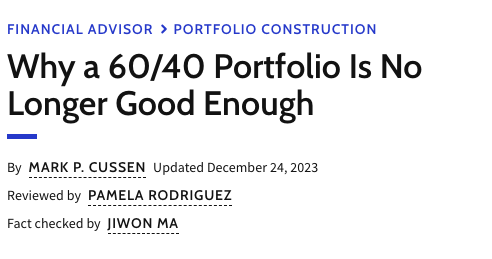
FOR MUCH OF THE PAST 40 YEARS, THE TRADITIONAL 60/40 PIE CHART OF STOCKS AND BONDS HAS PROVIDED GOOD UPSIDE GROWTH IN THE MARKET AND PROTECTION FROM BONDS WHEN THE MARKET HAS TAKEN A DIVE.
THAT ALL CHANGED IN 2022
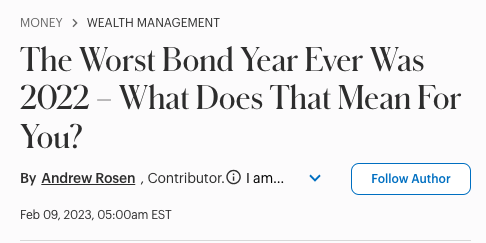
For the first time in nearly 40 years, interest rates were rising and bonds - which had been the steady anchor of most portfolios - became volatile and no longer offered the same diversification and protection from stock market volatility.
The fundamentals of the portfolio, that helped most Americans retiring in the next decade, shifted completely.
Source: Forbes.com
Source: Investopedia.com
Financial experts speculate seemingly daily about where interest rates will go in the coming months and years, but one thing seems likely: we will see more volatility in the bond portion of portfolios in the next 10 to 20 years than we have seen for most of the past 40 years.
This means that the same strategies you likely used to build your wealth throughout your working career are may be failing just as you NEED them to enter retirement.
PROBLEM 2: ACCREDITED INVESTORS HAVE ACCESS TO POTENTIALLY BETTER OPTIONS THAT YOU'RE NOT USING.
IF YOU HAVE $1M OR MORE OF NET WORTH EXCLUDING YOUR PRIMARY RESIDENCE, THEN YOU HAVE ACCESS TO SOME SOPHISTICATED INVESTMENT STRATEGIES THAT MAY PROVIDE YOU WITH BETTER OPTIONS TO PURSUE YOUR INVESTMENT OBJECTIVES.
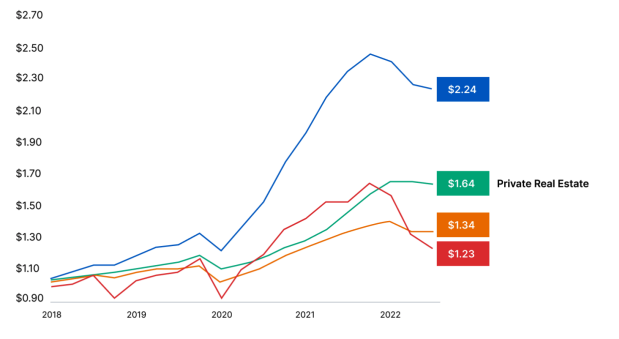
Once you see this chart below, you'll understand why 60/40 portfolios may leave you feeling like you're still slipping behind and not fulfilling your potential.
It's not some "secret of the super wealthy" even though many wealthy people do use what I'm about to show you.
Ultra High Net Worth families and University Endowments know something that many accredited inventors don't. They have access to a whole world of investing that many of the same accredited investors don't know about.
This approach to money management is already out in the open.
The rules to this game are known, but many of the people who could be playing are sitting on the sidelines because nobody ever showed them how.
Source: Hamilton Lane Data via Cobalt, Bloomberg (January 2023)
This chart shows the total returns between 2018 and 2024 for 4 different investment approaches. The top one returned 124%. That's an average annual return of 22%. The bottom one returned 23%. That's an average annual return of 5% per year...not much higher than inflation.
- The bottom line is the S&P 500, the stock market.
- The orange line that did a bit better is private debt - funds that lend money and collect interest.
- The green line that did substantially better is private real estate. This is probably not a surprise to you given what we all know about real estate.
- The line that blew everything else out of the water is private equity.
BUT WHAT'S IMPORTANT HERE ISN'T THE EXACT PERFORMANCE NUMBERS. THERE'S A REASON WHY ALL OF THESE INVESTMENTS DID BETTER THAN THE STOCK MARKET, AND WE CAN STRIVE TO TAKE ADVANTAGE OF THE SAME PRINCIPLES.
ALL THREE OF THESE INVESTMENTS BELONG TO A CATEGORY CALLED...
Start HereALTERNATIVE INVESTMENTS
WHAT ARE ALTERNATIVE INVESTMENTS?
THERE IS A DIFFERENCE BETWEEN LISTED AND UNLISTED INVESTMENTS.
Listed Investments
Listed investments are anything that you can find in the stock market. They are easy to buy and sell, there is generally more day-to-day trading and activity, and they are easily accessible to just about anyone.
Unlisted Investments
Unlisted investments are those that don't appear listed in the stock market. They can be more difficult to buy and sell. There can be less day-to-day trading and fluctuation, and access to some of them can be much more limited.
In short, this is a whole side of investing that is all but hidden to many who pursue investing through big-name stock brokers, banks, or pension funds.
These unlisted investments comprise some of the world of Alternative Investments.
"Alternative Investments" simply means anything that isn't publicly traded stocks or bonds.
- Residential real estate
- Commercial real estate
- DSTs
- Private Equity
- Private Placements
- Private Debt
- Art and Collectibles
- Commodities like oil, gold, or sugar
- Digital currencies
- Etc.
WHAT'S SO IMPORTANT ABOUT THESE TYPES OF INVESTMENTS? ... AND WHY DO WE RECOMMEND THAT NEARLY ALL OF OUR CLIENTS KEEP AT LEAST A PORTION OF THEIR PORTFOLIO ALLOCATED TOWARD ALTERNATIVES?
WE LIKE TO SEEK THREE SPECIFIC GOALS FOR ALTERNATIVE INVESTMENTS:
1. Historical Low Correlation with Growth Potential
These investments are historically less linked to the ups and downs of the stock market, so their performance has the potential to be decoupled from traditional market emotion and volatility.
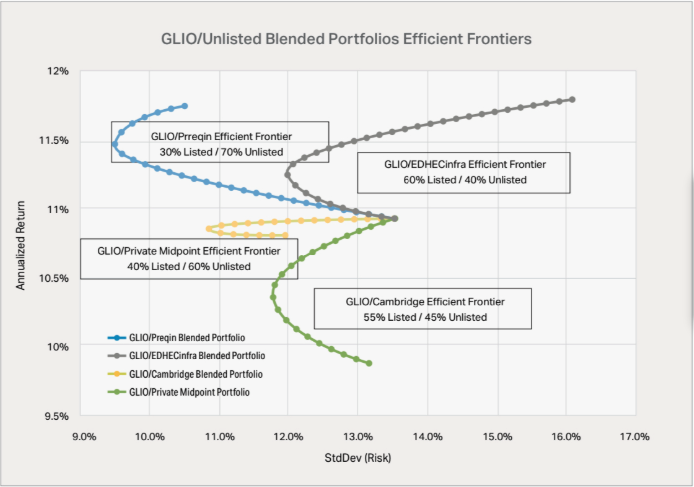
In fact, a certain study from ADISA illustrates how different blends of listed and non-listed investments can potentially provide relatively high annualized returns with relatively low volatility.
In simple terms, investors looking to unlink some of their investments from market volatility may do well to consider an allocation to certain alternative investments.
2. Passive Income Potential
The second goal we seek is Income potential.
Many alternative investments may act as effective passive income engines which is a requirement for anyone looking to transition to a work-optional lifestyle.
To understand this concept, imagine owning a rental property. You may benefit from longer-term growth in the form of appreciation of the underlying property, but you may also receive passive income in the form of rent payments.
The case is similar with certain alternative investments including differing ways of owning real estate.
3. Potential Tax Efficiencies
Many types of alternative investments provide potential for tax efficiency or sheltering. This may help to streamline and turbocharge specific investment objectives and life goals.
Think “Less drag and more thrust”.
In some of our videos and resources we offer through our in-house tax and accounting firm, we dive deeper into the world of tax efficiency and how the tax laws are written to incentivize and reward certain types of investing.
For now, understand that this potential tax efficiency is one of our three main pursuits for alternative investments.
So How Do We Go About Evaluating Alternative Investments For Our Clients' Investment Goals?
IN OUR EXPERIENCE, THERE IS A CERTAIN PROCESS AND ORDER THAT YOU MUST TAKE. IT INVOLVES SOMETHING LACKING IN MUCH OF THE FINANCIAL SERVICES WORLD...
LEADERSHIP.
While much of the financial services status quo involves REbalancing, REallocating, REacting to the market, and REsponding to your ideas and service requests, we believe that a true financial advisor should LEAD you through the financial aspects involved with the peaks and valleys of life.
We LEAD our clients through our three-step process:
Purpose. Planning. Portfolio.®

1. Purpose.
We believe that true retirement planning has to start with Purpose.
It's why OUR purpose is to help you to Live YOUR Purpose through financial Leadership where Life meets Wealth. We think living your Purpose means spending your time in ways that are enjoyable and fulfilling.
Once we have developed a clear picture of your retirement Purpose together, we can move on to the next stage
2. Planning.
The true job of a financial planner is to lead you down as few one-way streets as possible...to give you options for when life makes unexpected demands.
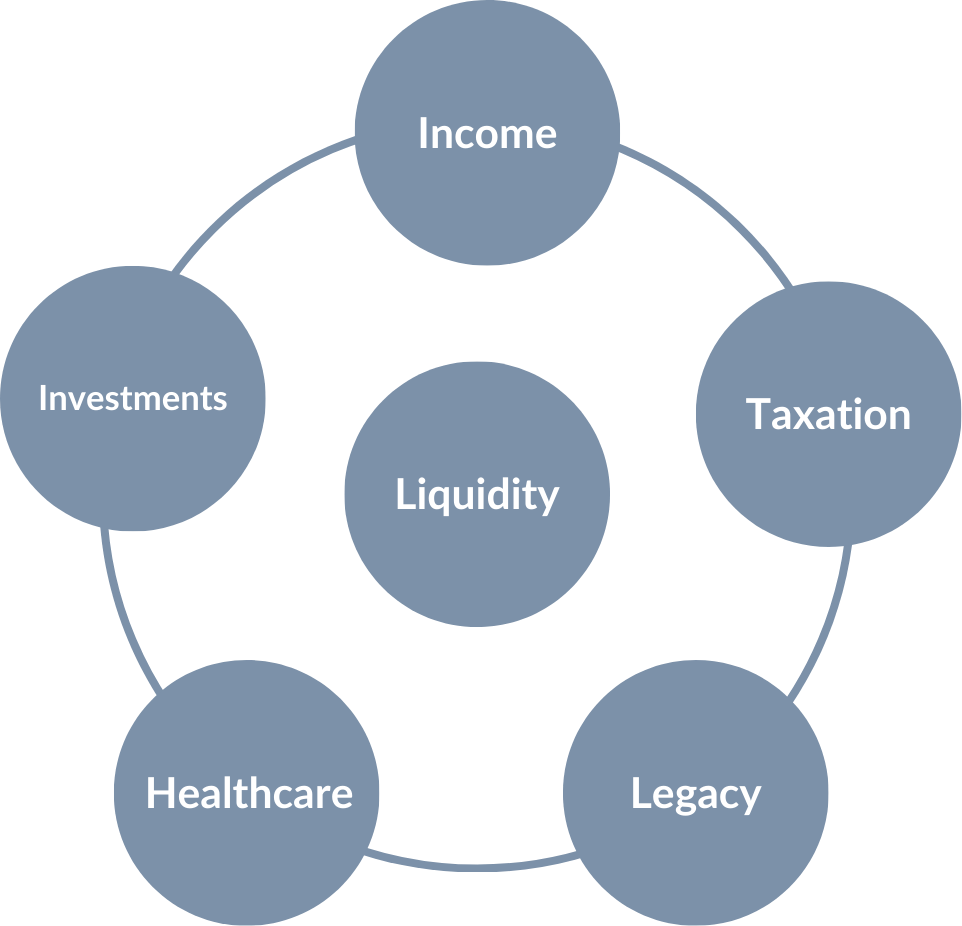
Deep-dive financial planning involves 6 distinct elements. If any of these elements is lacking, it can lead to uncertainty and a lack of confidence in your planning. These elements are Income, Investments, Taxation, Healthcare, Legacy, and perhaps most important... Liquidity.
Without planning for and coordinating each of these six elements to be tailored to your specific retirement Purpose and objectives, it really is a gamble whether or not things will work out the way you hope.

3. Portfolio.
Finally, once the Planning is completed in support of your Purpose, a tailored Portfolio of appropriate investments and strategies naturally reveals itself.
Discover How You May...
- Potentially increase your retirement paycheck up to 60% without requiring you to save more.
- Strive to retire between 1 and 5 years earlier than planned.
- Seek to uncover up to $150,000 in tax savings that other financial professionals may tell you "not to worry about."
- Look to protect your downside through historically low correlation investments so you can stop stressing about every news headline
Imagine This...
- Living your life without constantly thinking about Wall Street and the S&P 500.
- Knowing that you are pursuing the same tax efficiency strategies that institutions and the ultra wealthy use.
- Maybe even having some advanced strategies in place that have your friends wondering what has you so at ease - what do you know or have access to that they don't!?
Alternative investments aren't new. They are some of the oldest kinds of investments in existence.
AT RIDGEGATE® FINANCIAL, WE'VE BEEN USING THEM AS A TOOL TO HELP CLIENTS WORK TOWARD THEIR GOALS FOR MORE THAN 20 YEARS.
Alternative Assets under management totaled $13.7 trillion in 2021 and are projected to reach $23.2 trillion by 2027. People who study this space are calling the growth "meteoric." More and more investors are starting to question the storyline they've been fed about the stock market being the be-all, end-all of investing.
Wealth Management predicts that more than 1/5th of advisors will raise recommendations for allocations of alternative investments to more than 25% in the next couple of years.
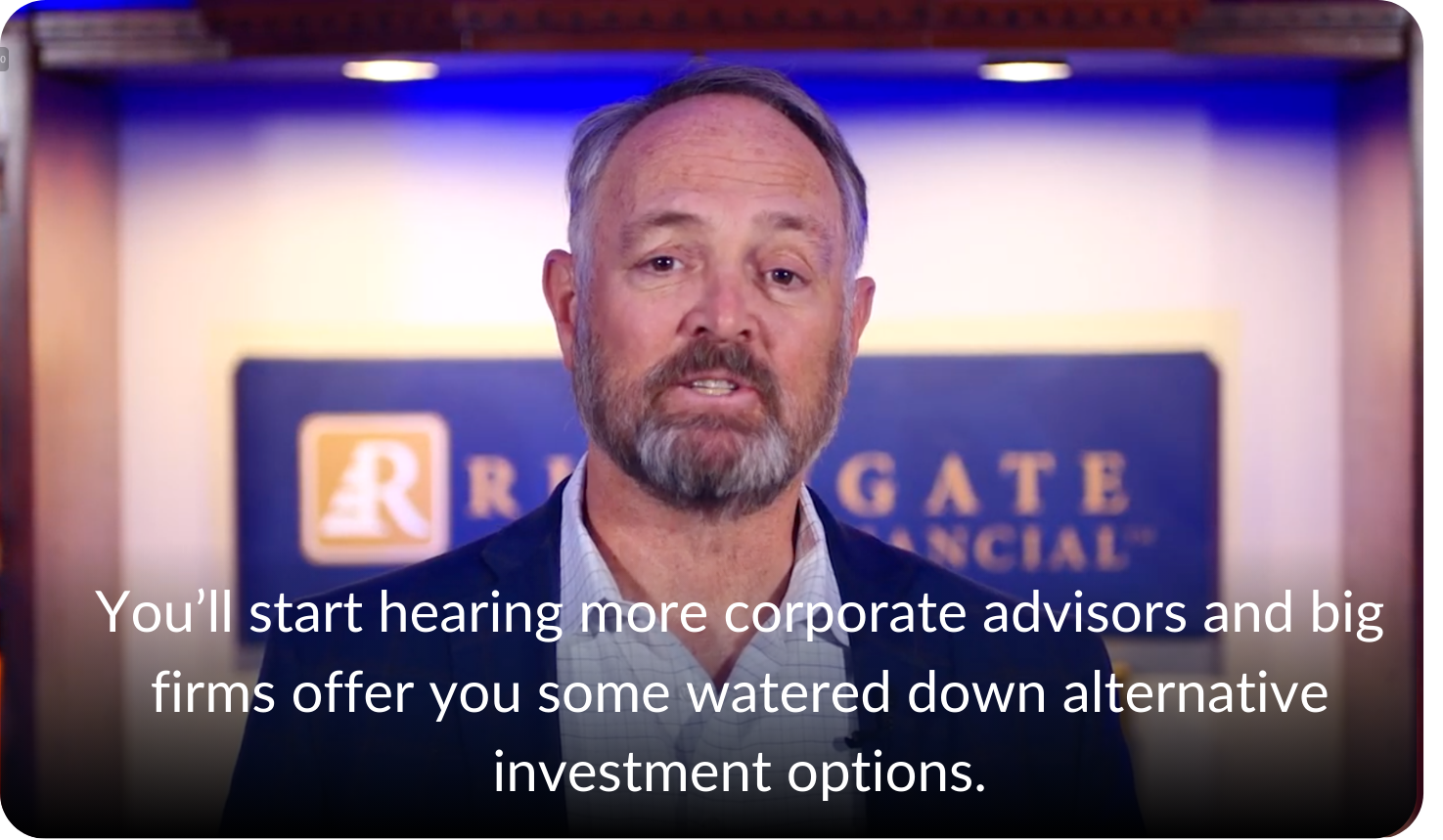
This may prove out our previous predictions that "you'll start hearing more corporate advisors and big firms offer you some watered down alternative investment options."
Source: Ridgegate® Financial, 2023

Source: altswire.com
In fact, the same Wealth Management survey reports that 60% of advisors are learning about alternative investments or plan to incorporate them into their client recommendations.
There is a reason that some of the wealthiest families on earth have graduated beyond pie chart portfolios and make regular use of alternative investments.
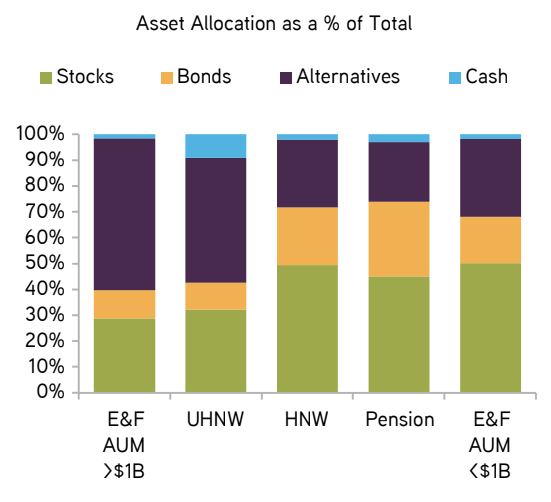
In fact, certain research shows that many Ultra-High-Net-Worth families (those with $30 Million or more in assets) keep around 30% or less invested in the stock market with upwards of 40-50% allocated toward alternative investments.
Endowments & Foundations | Ultra High Net Worth | High Net Worth
Source: The Wisdom of Compounding Capital
IN SHORT, WE BELIEVE IT MEANS THAT THE SAME STRATEGIES THAT ULTRA HIGH NET WORTH FAMILIES AND UNIVERSITY ENDOWMENTS HAVE BEEN LEANING ON FOR DECADES ARE BEGINNING TO MAKE THEIR WAY INTO HOUSEHOLD INVESTMENT PORTFOLIOS IN A BIG WAY.
All of This Is Why We Design Client Portfolios Using Something We Call...
THE ASSET STACK™
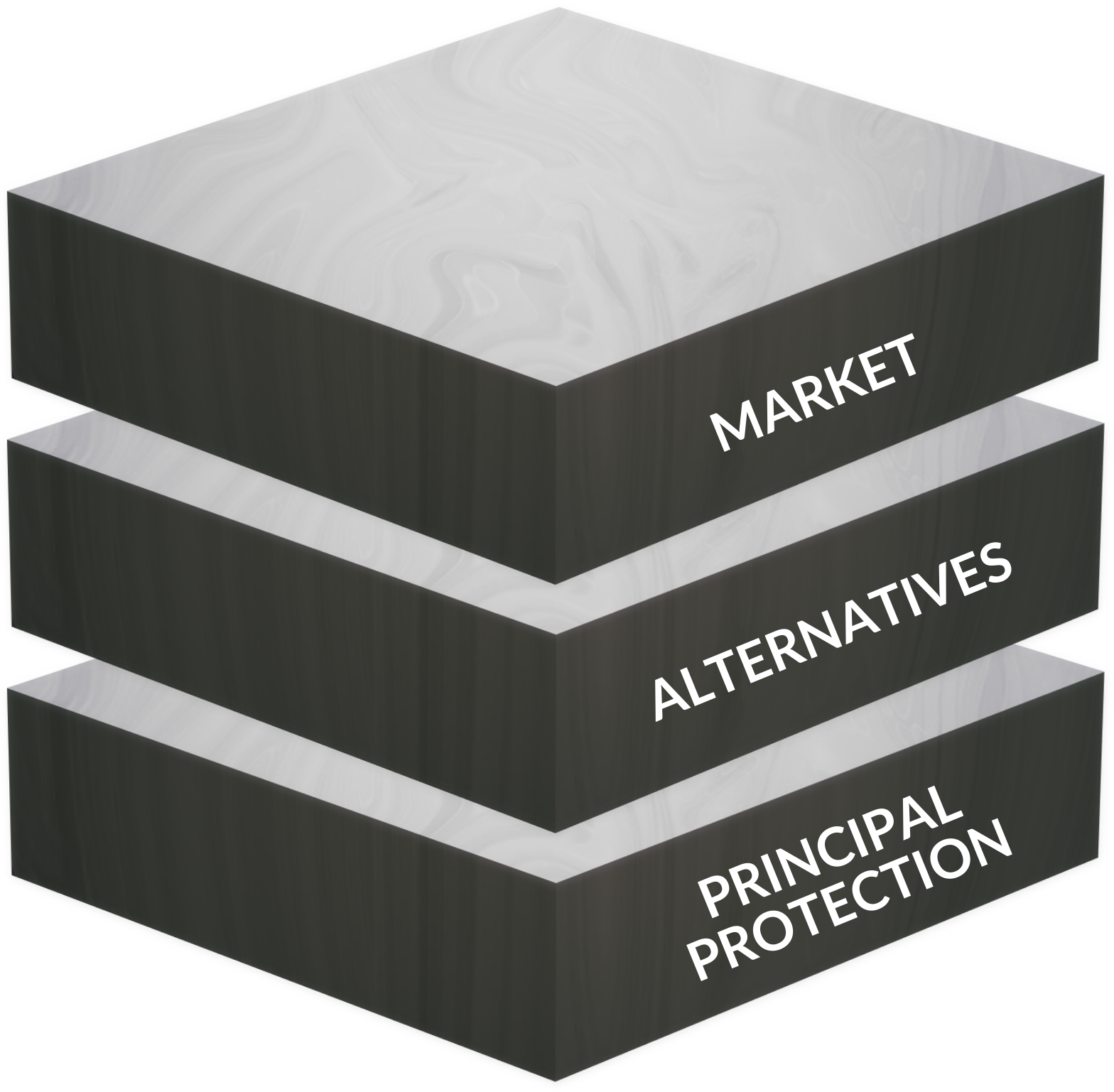

Market Investments
The top of The Asset Stack involves market investments--mostly think of the stock market. You're seeking the benefits of market growth when it happens, but you know that there is going to be volatility risk involved. We think that some percentage should be here--that amount will vary depending on your specific situation.

Alternative Investments
The middle of The Asset Stack involves alternative investments. We like to seek three specific goals for alternative investments:
- Historically low correlation to market volatility with growth potential
- Passive Income Potential
- Potential for Tax Efficiency
We also believe a certain percentage should be allocated to this category for most investors.

Principal Protection
There are two main jobs for this portion:
- Protection of Principal -- the goal here is to protect against loss
- Reasonable Rate of Return -- This isn't trying to beat- or even compete with the market, but rather striving for strong enough returns to help offset or eliminate inflation.
An appropriate allocation to this category seeks to anchor your portfolio in order to let the other two sections of The Asset Stack pursue their greatest performance.
FREQUENTLY ASKED QUESTIONS
One of the most common licenses for financial professionals to obtain, the "Series 6," only allows them to use mutual funds and annuities. If you've ever wondered why mutual funds and annuities are almost universally recommended, now you know. So over time, the mass-market approach to "financial planning" has become highly standardized.
Step 1: Ask a new client a few questions to determine their risk tolerance
Step 2: Stick them in a 60/40, 70/30, or 80/20 stock and bond pie chart powered by mutual funds and call it a day.
Which means if you told many financial professionals you wanted to invest in alternative assets, they would not be legally permitted to help you do that. They also wouldn't know how.
This isn't necessarily some "good guy vs. bad guy" thing.
It's more of a surface approach vs. deep-dive sort of thing.
Very wealthy people don't have to deal with that, because they are working with a different class of financial professional than most people have access to - investment professionals who would laugh at the idea that stocks and bonds are all you need to attempt to build wealth or manage taxes. Thankfully, all of that is starting to change.
We already discussed the tectonic shift towards alternative investments above.
Beyond that, many financial professionals will tell you investing in alternative investments is a bad idea, or at least that you don't need to bother, but when you look at where Americans are actually putting their money, you find something interesting.
- Retail investors — everyday folks in the $1-5M range — have on average about 5% of their portfolios in alternative investments, and 75% of their investments in stocks and bonds.
- High net worth investors have 49% of their money in stocks, and 26% in alternative investments.
- Ultra high net worth investors have 31% in stocks, and 50% in alternative investments.
Notice a trend? The more financially successful people are, the less they trust stocks and bonds, and the more money they put literally anywhere else. This goes against the advice regular, every-day Americans get about how they should protect and grow their money. So are these ultra-wealthy people just plain stupid? Are they careless because they have so much? Or is there a method to the madness?
In turns out that with investing, there are two games you can play:
You can play the "try not to run out of money before you die" game (which is what many people are encouraged to do)...
OR
...you can play the wealth-building game (and these games have different rules)
Many financial professionals are happy to charge you 1.5% per year to help you play the "try not to run out of money" game. But if you want to play the wealth-building game, we believe you need to approach things through the Purpose. Planning. Portfolio.® framework, and with The Asset Stack™.
We offer a different approach to money management than you've likely seen before, because we have one simple goal:
We want to help all our clients get to a "work optional" lifestyle as fast as possible.
That means a lifestyle where you aren't shackled to a paycheck...
And there you can work--or choose not to work--because you want to, not because you have to...
Whether you're 35 or 65, we believe the ultimate value money can provide is to give you freedom and options.
That's what really separates the "wealthy" from everyone else, not an arbitrary number in the bank.
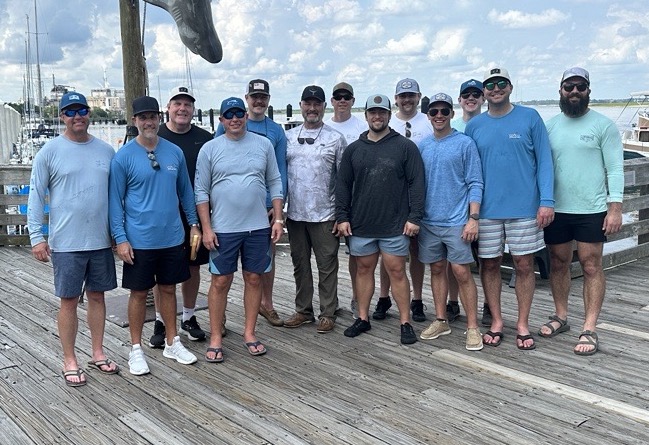
Some members of our team having fun after one of our regular high-net-worth training events.
Our purpose is to help you Live Your Purpose through financial leadership where Life meets Wealth.
Who Are We?
Meet our team of financial planning professionals.
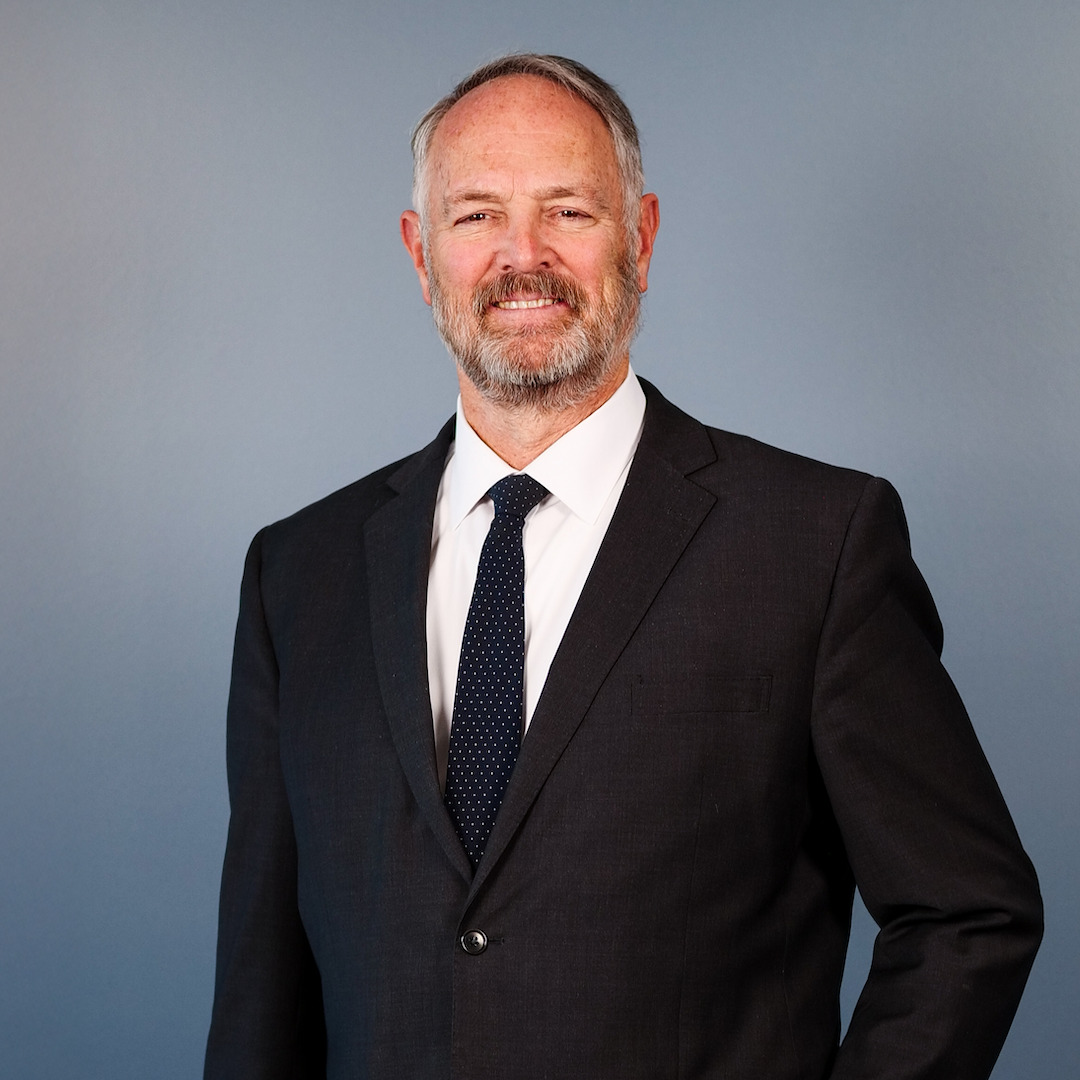
Wally Smith, ChFC® RICP® | Founder & CEO
Wally Smith received his Electrical Engineering degree from University of Illinois and quickly leaned into the business development realm of engineering. He founded Ridgegate® Financial in 2003 as an independent wealth management firm treating retirement and family financial planning differently – looking at each family as "Client, Inc".
Read Full Bio
Alex Staverosky, CFP® | Wealth Advisor & Realtor
As a Real Estate Strategist & Financial Advisor with Ridgegate® Financial, Alex Staverosky helps high net worth individuals and real estate investors strive to use their finances to proactively and efficiently achieve their goals at every stage of their life.
Read Full Bio
Chris Rogers | Wealth Manager
As a Wealth Advisor with Ridgegate® Financial, Chris helps clients meet their financial and investment concerns head-on in order to actively pursue their purpose by providing creative and practical financial strategies and solutions. Throughout his 15 years in the field, Chris has gained valuable insight into the needs of his clients.
Read Full Bio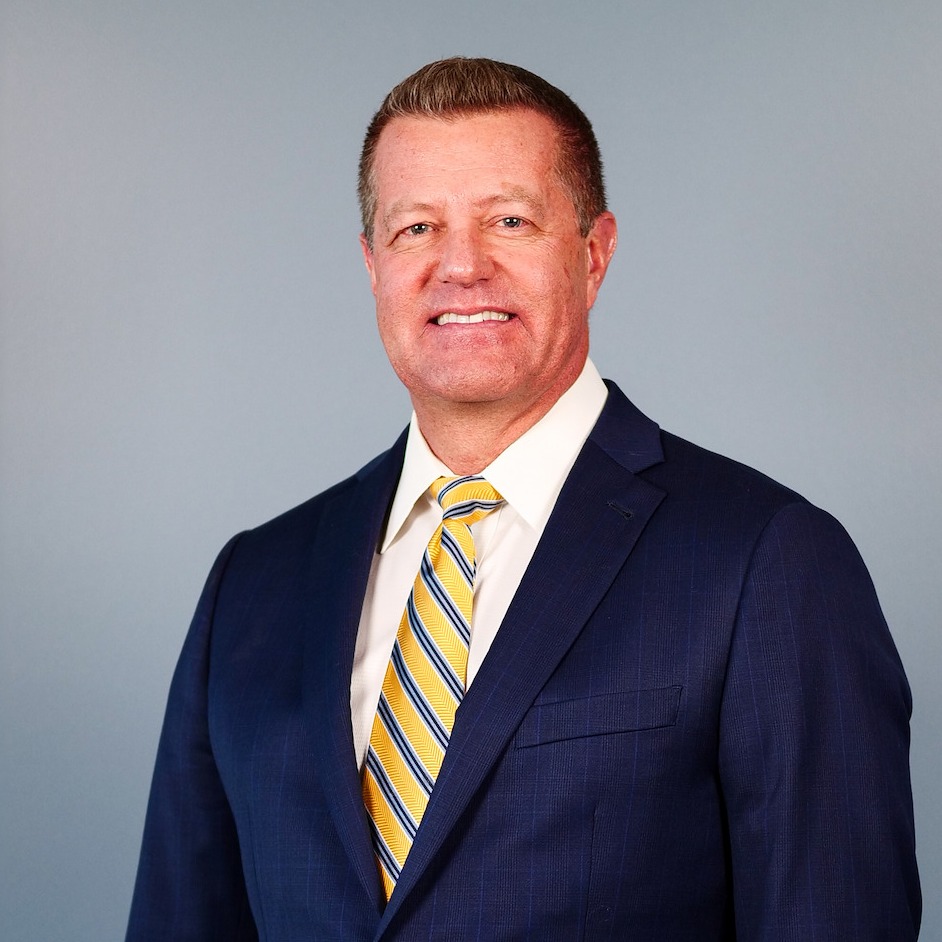
David Swenson | Wealth Manager
As a Wealth Advisor with Ridgegate® Financial, David is dedicated to delivering tailored solutions for each of his client's unique needs. With over 30 years of experience in the field, David has gained vitally important experience weathering a multitude of economic cycles and strives to instill confidence and clarity throughout life's challenges.
Read Full Bio